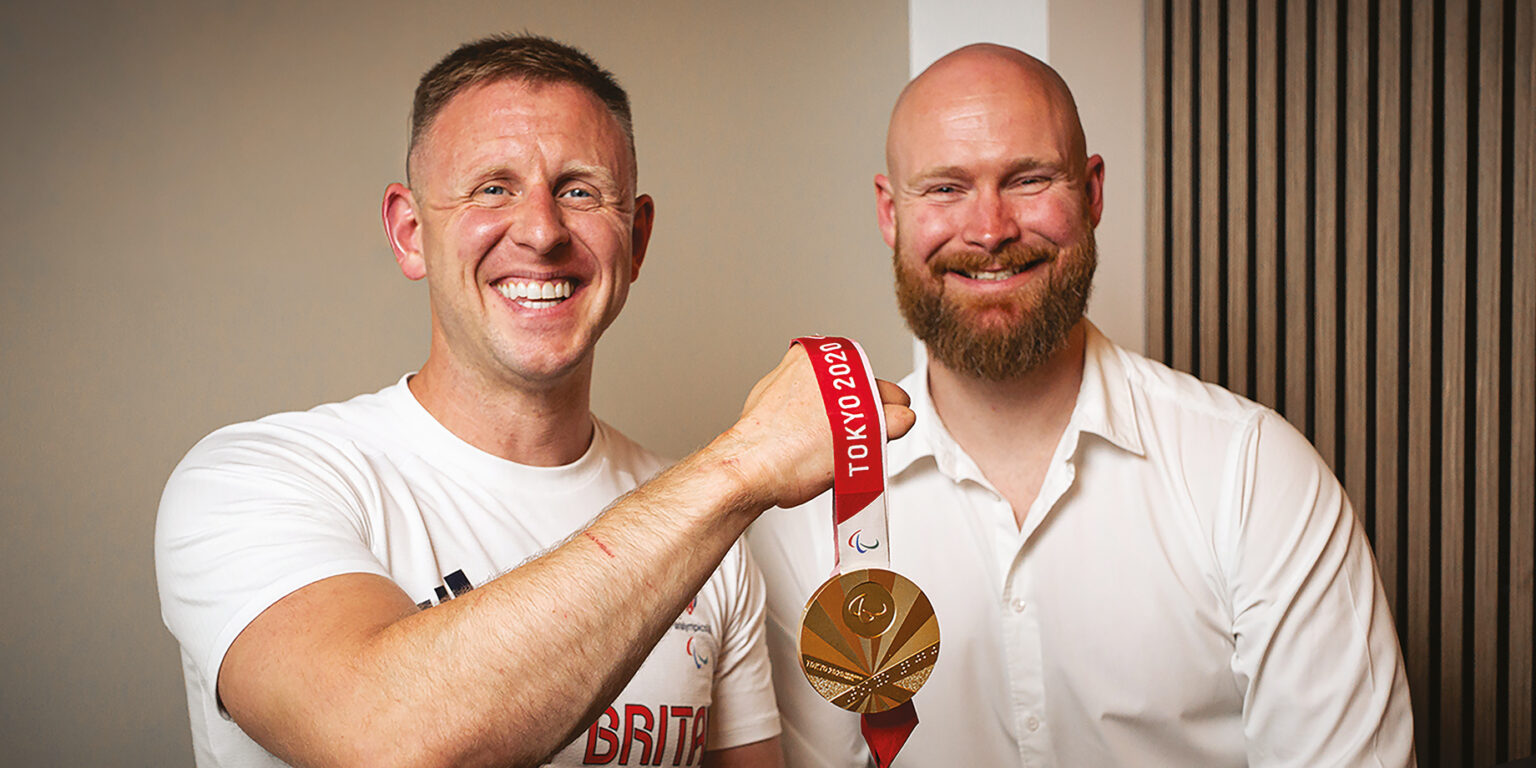

At 15 years old, Aaron Phipps contracted meningitis and lost both legs and most of his fingers to blood poisoning. Rather than letting these life-changing events hold him back, he achieved a remarkable feat. He has completed the London Marathon twice, finishing in fourth place in 2009, in less than two hours. In 2016, he became the first double amputee to climb Mount Kilimanjaro unassisted. He’s also been a member of the GB wheelchair rugby squad, representing his country at three Paralympic Games and winning gold at Tokyo 2020. Reflecting on his illness, Phipps says “It was incredibly tough, but probably both the worst and best thing that’s ever happened to me. The worst for obvious reasons, but the best because it gave me a completely different outlook on life and got me working with people like Jon.”
Changing times
Indeed, while Phipps’ name is on the medals and in the record books, Jon Cooper’s role as coach, mentor and friend has been of equal importance, the pair say.
“I was reintroduced to Aaron just casually, because I was studying for my Master’s at [Southampton Solent] university at the same time he was training there for his Kilimanjaro trip,” Cooper says. “We’d met before the 2012 Paralympics, but he didn’t know me then. As we grew older, we just clicked.”
Calling their connection a “bromance,” Cooper notes their mutual appreciation and collaborative approach to creating a shared environment rather than a standard coach-athlete setup.
However, when they began working together in 2017, their dynamic was far more professional and transactional in nature.
Phipps explains that after competing in 2012, he rejoined the squad targeting the 2020 Games with an experienced, independent mindset.
Cooper acted as a directive sports scientist until Covid-19 abruptly disrupted their routines.
“We both dropped our egos because we were thrown into this kind of ‘tornado of sh*t’.”
Uncomfortable truths
Phipps recalls how losing access to their world-class gym with its £150,000 treadmill and team of technicians forced them to drop their egos and confront uncomfortable truths. “I think what made our connection so strong was all the walls coming down at this point – we both dropped our egos because we were thrown into this kind of ‘tornado of sh*t’. I couldn’t pretend to be this big-bully athlete any more and Jon hadn’t got any of his fancy equipment. That was when we started being really honest with each other and when the real collaboration started to happen.”
Cooper adds that they formed a “performance bubble,” meeting on paths or in parks. Unsure if Aaron’s indoor wheelchair could manage outside, they made it work by using an inclined path for resistance training.
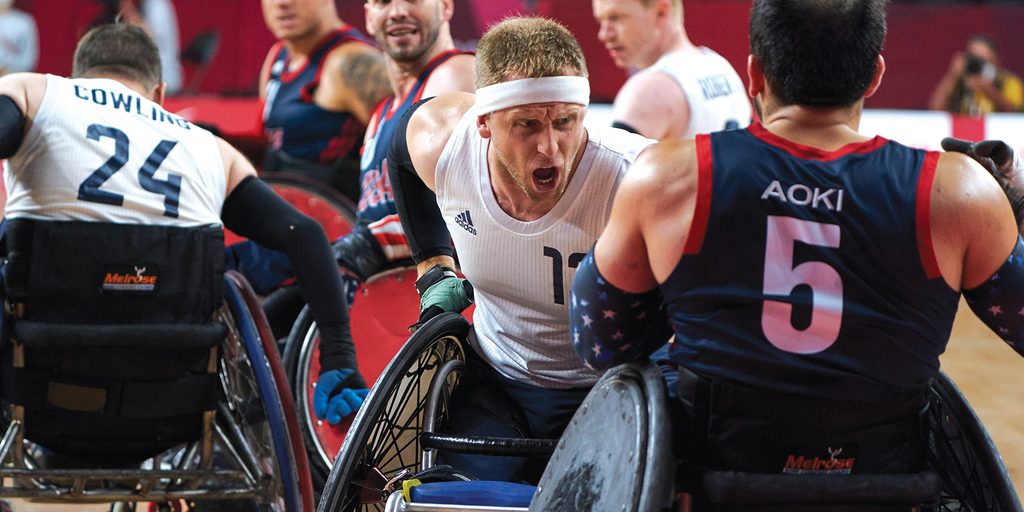
Phipps and his GB team-mates beat Japan on their way to Paralympic gold
Game on!
Gradually, Cooper and Phipps found a way to make things work and, in doing so, realised that this more authentic, honest version of their relationship was far better than the sanitised professional one they’d left behind.
“We were ‘game on – let’s be the best in the world’,” says Cooper. “We found a way for it not to matter where we were or what we had access to and adapted to make the unchangeable situation work for us.”
And work it did. Phipps went on to be part of the best wheelchair rugby team in the world, which beat the number one side in the world, Japan, at their home Paralympic games, Tokyo 2020 – securing the first-ever gold medal for a European side in a team Paralympic event.
“I had to lose 30% of my body before I started to use 100% of my potential, but people don’t have to go there to find that momentum – we want to teach them our processes so they don’t have to”
Lessons in adversity
The pair now coach and advise in the world of business, helping leaders boost their performance by applying the same tactics the pair learned in sport.
But is terrible adversity always necessary before progress can be made?
“I had to lose 30% of my body before I started to use 100% of my potential, but people don’t have to go there to find that momentum – we want to teach them our processes so they don’t have to,” says Phipps.
“Although things in life are sometimes crap, you have a choice about how you behave.”
Cooper agrees: “You find this ‘micro-adversity’ everywhere. I remember one time, when we were training on that path during the pandemic, and Aaron burst a tyre. You can either say, ‘Ah, do you know what, let’s call it a day there’ and go home, or you can say, ‘That’s a setback. But let’s just change the tyre and crack on.’ It’s an attitude thing, a state of mind.
Drop the ego
Do Phipps and Cooper find that getting rid of ego can foster an environment in which risk taking is more encouraged, and an atmosphere of ‘psychological safety’ is created?
“I dislike the word ‘safety’ because it implies a threat to sharing ideas,” Cooper says.
“If the threat is between you and a colleague, then it vanishes as soon as you remove ego from the equation.”
When it doesn’t matter who owns an idea, a bad one becomes a data point rather than a personal failure, he adds. “You might try 50 ideas to get 10 that work.”
Phipps agrees, noting that in high-pressure roles, true safety is an illusion. “You can’t stop external criticism. Accept it and push past your comfort zone – that’s where top achievements happen.”
He emphasises focusing on the next move after mistakes, criticising teammates puts them off their game, but telling them to move on fosters performance. We all drop the ball. Cooper adds that micro-management – something they see often – is also a product of ego. “If you catch yourself thinking, ‘I’m going to make you do this task the way I want you to do it’, then you are assuming you, and you alone, have the right answer.
“When I’m working with someone like Aaron, he’s an expert in his field. I’ve never been in the chair. He’s got that expertise, not me.
“I want to understand the athlete, not the sport”
The common language of performance
Phipps and Cooper will both always need a challenge in life. Now retired from wheelchair rugby, Phipps is turning his attention to pistol shooting, with the aim of representing GB at the 2028 Paralympics, and Cooper will still be right by his side as coach.
“I’m not an expert in shooting in any way, shape or form,” says Cooper, “but that’s OK because Aaron’s going to become the expert in shooting, and there will be other technical coaches who deal with that side of things. I always want to understand how to work with the athlete, not the sport.”
It’s hard not to feel uplifted by the pair’s infectious enthusiasm. Does Phipps think he would still exude such positive energy if he hadn’t been through such a challenging time as a teenager?
“No, I don’t think I would,” he says. “Psychological safety, resilience, risk taking – for me, it’s all linked to that time in the hospital, where I became so aware of my own mortality.
“I wasn’t making the best choices as a teenager. I was a bit of a wimp, but I remember thinking, ‘if this can’t kill me, then nothing can’.
“It gave me determination and a drive. I had literally stared death in the face, which made all the normal fluff that worries a 15-year-old boy disappear. It made me laser-focused.”
If Phipps could travel back in time and give his hospital-bound teenage self a piece of advice, what would it be?
“When I went to collect my gold medal at Tokyo, there was this place marker on the floor that said, ‘Wheelchair rugby, gold medal. Aaron Phipps.’
At that moment, I remember thinking I wish I could go back to that scared 15-year-old boy and say: ‘Do you know what? It works out right in the end’.
“That was probably the first time in my life I felt settled. I’d achieved something. I was the best in the world. That was my special moment.”
Dr Ian Farrell is a writer and editor at CPL One.
This article is also available in the autumn 2026 issue of Edge magazine