
Rubin’s path to success has not been smooth – his leadership has encountered challenging market forces, Covid lockdown impacts and ever-changing consumer behaviour trends.
“I am a fourth-generation cobbler… And my father’s advice to me was quite clear: do not become a shoe manufacturer!”
Rubin’s father wanted him to become a chartered accountant. He qualified with one of the big accountancy firms at the time, Touche Ross (which later merged with Deloitte).
“I quite enjoyed it,” he says. “I had a wide range of clients and performed audits on businesses ranging from the huge General Electric Company to a small artificial flower maker in central London – so it was varied and gave me a good insight into running a business.”
A new role
Then two things happened: after a brief spell in the banking sector, Rubin took a job as a commercial financial director for an entrepreneur who had taken over a demolition company and wanted to expand into other areas.
“I ended up leaving because I didn’t see my future in demolition. However, it taught me an important lesson about conducting proper due diligence before accepting a job or contract.”
The second thing that happened was that his father needed help in his manufacturing business. It was the early 1970s – a great time for footwear fashion. Rubin found he really enjoyed working in shoe manufacturing and he fell in love with the product. “It’s so interesting,” he tells me enthusiastically.”
“I had become more and more fascinated by the product, seeing it made and designing it”
Hook, line and sinker
When Rubin’s father died in 1976, they decided to sell their shares in the family business to his dad’s business partner – but the shoe bug had really bitten Rubin by then, so he went to work for his uncle, who was also a cobbler and a very astute manufacturer.
Rubin worked with his uncle for about 10 years, who taught him a lot about leadership. By the early 1980s, however, manufacturing was moving out of the UK to overseas factories.
“By this point, I had started to move into importing products and this is where I decided to focus,” Rubin says.
“I had become more and more fascinated by the product, seeing it made and designing it. Because I knew the manufacturing process, I was able to give overseas factories that I worked with designs that would work well for a UK market – and so I became an importer, supplying the large retailers in the UK.”
On leadership legacy
You spend so long at work that you’ve really got to enjoy it. Not that it is always enjoyable – there are obstacles and external factors to deal with. But when people say to me “I really enjoy working for Dune”, it makes me very happy. As a leader, you try to foster a culture in which, although the work may be demanding, the atmosphere is friendly and welcoming. That’s so important. I’d be delighted with the legacy of creating a company where people enjoy working.
Where it all began
Rubin set up his own footwear import company, called Browning, gradually building up a team and travelling around the world visiting manufacturers. He also started to dip his toe into the retail world, partnering with a factory in Spain to design and make shoes that were sold in high street stores. In 1992, the Dune brand was born.
“When I started Dune, I was running the two businesses in parallel. The import business was very much funding the retail business, because that was slow to grow. In 1993, we opened our first shop on King’s Road in Chelsea, London, and our second shop, in Kensington High Street, opened a year later.
“It took time to finesse exactly what the brand stood for. Once we’d established that – the ‘affordable luxury’ element – we opened half a dozen shops and branched into shopping centres, and then we did become more ambitious.”
“As a leader, the most difficult decision is whether to persist with something when you hit challenging times, or make a decision to fail fast, walk away and learn from that experience”
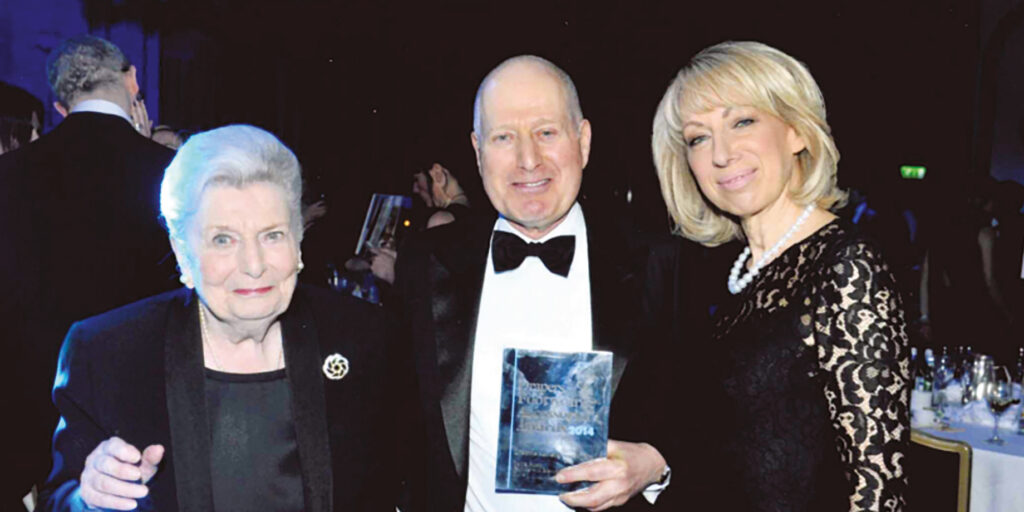
Rubin with his mother, Dorie (left), and his wife, Anne, after receiving the Drapers Lifetime Achievement Award in 2014
Leadership lessons
Although innovation is important, Rubin believes, as a leader, you should never lose your focus. “Many leaders, particularly entrepreneurs, want to do lots of different things, but I’ve learned that you need to get your core offering absolutely right, because that is what is going to deliver the main results.”
He pauses. “As a leader, the most difficult decision is whether to persist with something when you hit challenging times, or make a decision to fail fast, walk away and learn from that experience.”
On team building
When it comes to hiring, attitude really matters – I rate it above qualifications. You can teach and train someone to develop their skill set, but if they don’t have enthusiasm and a positive attitude, then it can become a challenge.
A recent Retail Week report1 found that 66% of the people interviewed did not see retail as their future career, which is very depressing. The challenge for business leaders is to make retail interesting and exciting. Great managers can motivate their team to achieve this.
Strength to strength
Although Browning had been successful as one of the largest importers of private-label fashion footwear in the UK, changes in the market meant its margins were being squeezed by 2004. Rubin decided it was time to devote more time to Dune, which was establishing itself in the market space between luxury brands and traditional high street chains.
By 2009, Dune a major player in the market, and was turning over £50m a year in sales (making a £2m profit per year). The business also acquired Shoe Studio. Rubin says this acquisition transformed the business, and between 2010 and 2020, sales grew to £200m per year – but then the Covid-19 pandemic hit.
Tough times
High street stores and shopping centres were closed down during the lockdown, but there was also an issue for Dune’s online product.
It was a tough time; Rubin admits there were points where he thought the company might not survive. “With any shock, you have to rethink some business fundamentals. It was a very difficult time – we had to make a lot of changes and a lot of difficult decisions, including losing some staff.
“Although by 2022 our turnover had gone down to £140k per annum, we had a sharper business focus. This meant we were in a better position to become a global brand, because our efforts were very much on the one brand.”
This is the direction Rubin and his team are now heading. Currently, 35% of Dune London’s sales are international, and the plan is to increase this to 50% in the next five years.
Going global
After leading the company through the pandemic, in 2022, Rubin – at age 75 – decided it was time for someone else to see the company through its next stage of growth. Nigel Darwin is now CEO, with Rubin as chairman. Although he has stepped back from the day-to-day running of the business, Rubin still attends range reviews, oversees the creative direction for the brand and inputs into the strategy. He also still loves visiting stores.
I ask if handing over the reins has been difficult. “You’ll need to ask my management team! I have a weekly catch up with Nigel and I have to be very strong to not become involved in the day-to-day. But it is hard, because I built this business up, and I have been here through the good and the bad.”
On advice for my 18-year-old self
Keep an eye on the bigger picture – take the time to step back and look at where things are going – and be brave to stop what you’re doing to change direction. There were times when I didn’t respond to change quickly enough. For example, we should have stopped the manufacturing business about five years before we did, because the writing was on the wall for UK manufacturing at that point. But, especially when you’re starting out in a business, you’re very much involved in the day-to-day running of it, so you don’t get much chance to pause and reflect on the direction of change.
Changing times
Rubin has also taken up writing – first his biography, which he enjoyed so much that he is now writing a novel. Researching for his memoirs allowed him the opportunity to reflect on the changes to the retail sector through which he has led his business.
Daniel Rubin is the founder and chairman of the Dune Group, and the author of Sole Survivor: How I Built a Global Shoe Brand, published by Canbury Press.
This article is also available in the summer 2026 issue of Edge magazine